TPO vs. EPDM vs. Modified Bitumen: Choosing a Flat Roof System
Flat and low-slope roofs need a different kind of roofing than the shingles or metal panels used on steep roofs. Instead of shedding water down a slope, a flat roof relies on a continuous waterproof membrane to keep water out. Three membrane systems dominate the flat roofing market in Ontario — TPO, EPDM, and modified bitumen — and each has genuine strengths and trade-offs. Choosing the right one depends on the building, the budget, and the priorities driving the project.
This guide compares the three systems head-to-head, without favouring one over another, so you can understand which suits your situation. After more than 50 years of flat roofing work across commercial and residential properties in the Ottawa Valley, we install all three systems and match the system to the project rather than pushing a single option. For the broader overview of flat roofing, see our flat roofing solutions guide.
What Each System Is
Understanding how each membrane works is the foundation for comparing them.
TPO (Thermoplastic Polyolefin)
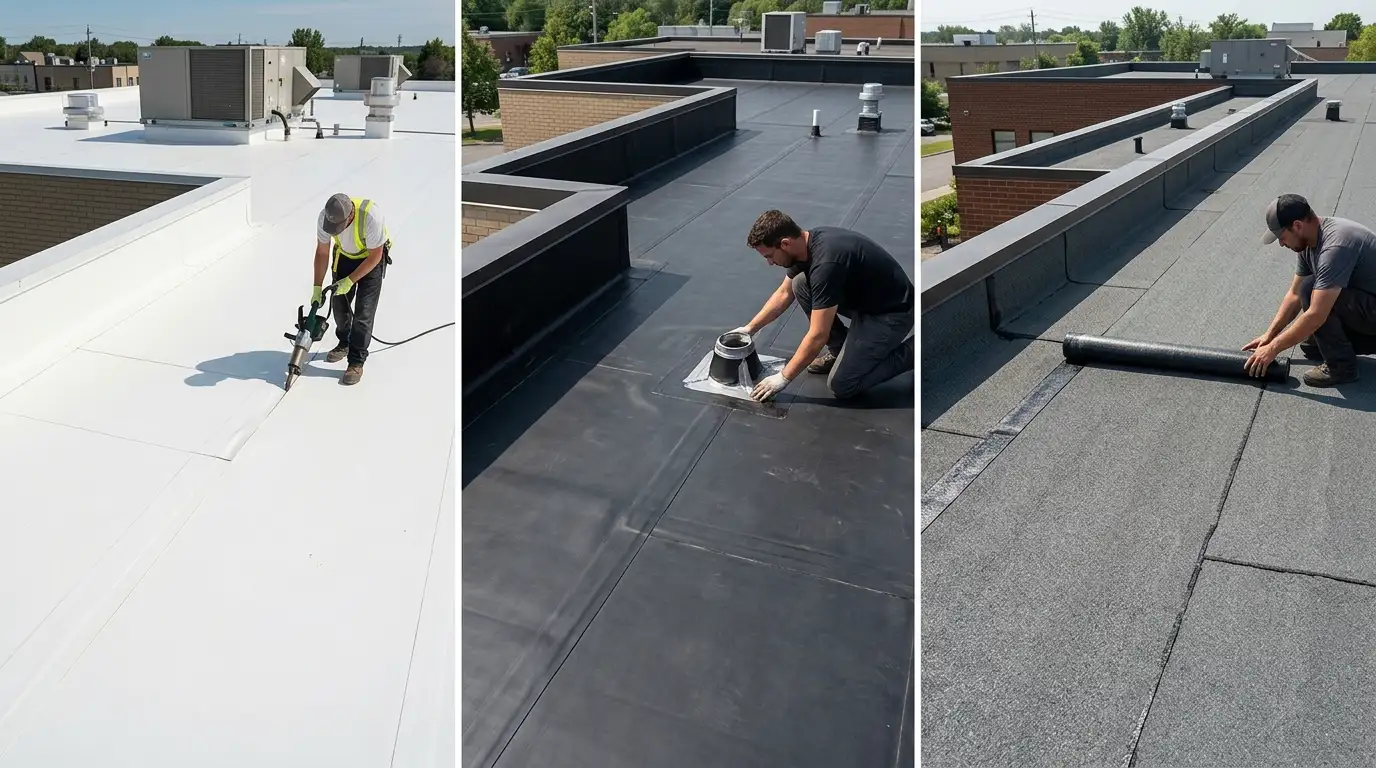
TPO is a single-ply membrane, meaning the roof is waterproofed by one layer of synthetic material. TPO sheets are rolled out across the roof and the seams are heat-welded together, creating a continuous, monolithic waterproof surface. TPO is typically white or light-coloured, which gives it strong reflective properties. It is the newest of the three systems and has grown rapidly in popularity for commercial flat roofs. Our TPO roofing overview covers the material in more detail.
EPDM (Ethylene Propylene Diene Monomer)
EPDM is a synthetic rubber single-ply membrane, usually black, that has been used on flat roofs for decades. Like TPO it is installed as large sheets, but the seams are typically joined with adhesive or seam tape rather than heat welding. EPDM is known for durability and a long track record — it is the system many building owners think of first when they picture a rubber roof. Our EPDM roofing overview has more detail.
Modified Bitumen
Modified bitumen is an evolution of traditional built-up (tar-and-gravel) roofing. It consists of asphalt-based sheets reinforced with polyester or fibreglass and modified with polymers for flexibility and durability. The sheets are applied in layers — torch-applied, cold-applied with adhesive, or self-adhered — building up a robust multi-layer waterproof system. Modified bitumen bridges the gap between old-style built-up roofing and modern single-ply systems. Our modified bitumen overview covers it further.
Cost Comparison
Cost varies by system, building, and installation complexity, but the general positioning holds:
EPDM is typically the most economical of the three to install, which is part of why it has remained popular for decades. For budget-conscious projects where proven waterproofing is the priority, EPDM often makes sense.
TPO sits in the mid-range and has become more competitive as it has grown in popularity. Its energy savings (from reflectivity) can offset some of the cost over time on the right building.
Modified bitumen can range from mid to higher cost depending on the number of layers and the application method, reflecting the more labour-intensive multi-layer installation.
Upfront cost is only part of the picture — lifespan and energy performance affect the true cost over the life of the roof. For a broader look at what shapes roofing cost, see our guide on what affects the cost of a new roof in Ontario.
Lifespan and Durability
All three systems, properly installed and maintained, deliver decades of service, but they differ in their characteristics.
EPDM has the longest proven track record and excellent longevity — well-maintained EPDM roofs routinely last 25 to 30 years or more. Its rubber composition handles temperature extremes and UV exposure well over time.
TPO is newer, so its very-long-term track record is still being written, but quality TPO installations are engineered for comparable lifespans. The heat-welded seams are a durability strength — a properly welded TPO seam is extremely strong.
Modified bitumen is highly durable and resistant to physical damage thanks to its multi-layer construction. The layered build makes it forgiving of foot traffic and mechanical wear, which is valuable on roofs that see regular access.
Energy Performance
This is where the systems differ most noticeably, and it matters in Ontario's climate.
TPO leads on reflectivity. Its white surface reflects solar heat, keeping the building cooler in summer and reducing air conditioning load. For buildings with significant cooling costs, TPO's reflective performance is a real advantage.
EPDM is traditionally black, which absorbs heat. In summer this increases cooling load, but in Ontario's long winters the heat absorption can be a modest advantage, helping melt snow and reducing heating demand. EPDM is also available in white for reflectivity when cooling is the priority.
Modified bitumen falls in between and depends heavily on the surface finish — reflective granulated caps or coatings can improve its energy performance significantly.
Seam and Leak Considerations
On a flat roof, the seams are the most vulnerable points, and how each system handles them matters.
TPO heat-welds its seams, fusing the sheets into a continuous membrane. A properly welded seam is one of the strongest in flat roofing, which is a significant point in TPO's favour.
EPDM traditionally uses adhesives or seam tape. Modern EPDM seaming is reliable, but the seams require correct installation and can be a maintenance point over decades.
Modified bitumen creates overlapping, bonded layers rather than discrete seams, and the multi-layer approach provides redundancy — if one layer is compromised, others remain. When leaks do occur on any flat roof, prompt attention matters; our flat roofing leak repair and flat roof repair services address the common failure points.
Which System Suits Which Project
There is no universal winner — the right system depends on the building and the priorities.
Consider TPO if:
- Energy efficiency and summer cooling costs are a priority
- You want strong, heat-welded seams
- The building benefits from a reflective white roof
- You want a modern single-ply system at a competitive cost
Consider EPDM if:
- Budget is a primary concern
- You value a decades-long proven track record
- The building would benefit from heat absorption in winter
- You want a simple, durable, time-tested rubber membrane
Consider Modified Bitumen if:
- The roof sees regular foot traffic or mechanical wear
- You want multi-layer redundancy in the waterproofing
- The building has complex details or transitions
- You value physical durability and puncture resistance
Residential vs. Commercial Flat Roofs
All three systems are used on both residential and commercial flat roofs, but the considerations differ. Commercial buildings often have large roof areas where TPO's reflectivity and EPDM's economy scale well, and where rooftop equipment access makes modified bitumen's durability valuable. Residential flat roofs — additions, modern homes, low-slope sections — are often smaller and may prioritize different factors. Our residential flat roofing and commercial flat roofing service pages cover the applications for each.
Why Professional Installation Determines Success
With flat roofing more than any other type, installation quality determines whether the roof performs. A flat roof has nowhere for water to go if the membrane fails — no slope to carry water away from a weak point. This makes the quality of the seaming, flashing, and detail work absolutely critical, regardless of which system you choose.
Each system also requires specific expertise: TPO requires proper heat-welding technique, EPDM requires correct seaming and adhesive application, and modified bitumen requires skilled multi-layer application. A contractor experienced in all three can recommend the right system honestly rather than defaulting to the one they happen to know. Our thoughts on choosing local roofing contractors apply strongly to flat roofing, where experience with the specific system matters enormously.
Get Your Free Estimate
Not sure which flat roof system is right for your building? Our team installs all three and will recommend the system that genuinely suits your project, budget, and building — no obligation.
Fill out the form or reach us directly.
Call us at (613) 259-5766 or contact us to schedule your on-site assessment.
Three Good Systems, One Right Fit
TPO, EPDM, and modified bitumen are all proven flat roofing systems, each with genuine strengths. TPO leads on energy efficiency and seam strength, EPDM on economy and track record, and modified bitumen on physical durability and redundancy. The right choice comes down to your building, your budget, and what matters most for your project. McKay Roofing installs all three across the Ottawa Valley and will help you match the system to your needs.