Standing Seam vs. Ribbed Steel: Choosing the Right Metal Roof Profile
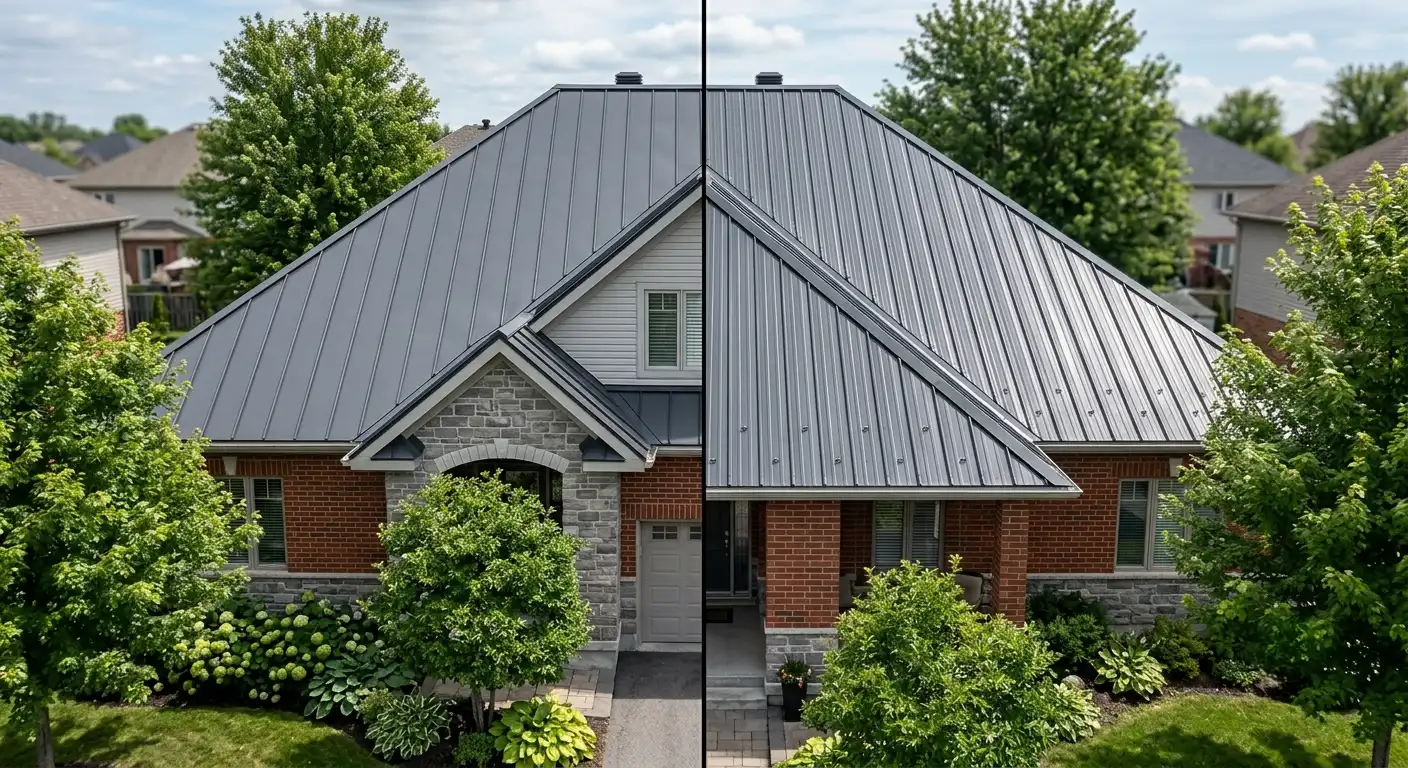
Once an Ontario homeowner decides on a metal roof, the next question is which profile. Standing seam and ribbed steel are the two dominant residential metal roofing systems installed across the Ottawa Valley, and while both offer the durability, longevity, and weather performance that make metal such a compelling choice, they are meaningfully different products. Understanding those differences — construction, aesthetics, weather behaviour, cost, and installation complexity — helps you choose the profile that best fits your home.
After more than 50 years installing both systems across Lanark, Perth, Almonte, Carleton Place, and the wider Ottawa Valley, we have learned that neither profile is universally "better." The right answer depends on the home, the budget, the aesthetic preference, and the specific conditions the roof needs to handle. This guide is a balanced head-to-head to help you decide.
What Standing Seam Actually Is
Standing seam is the premium metal roofing profile. It consists of long vertical panels that run from the eave to the ridge, joined at the seams by raised interlocking edges — the "standing seams" that give the system its name. The seams sit above the flat panel surface and provide a mechanical, watertight connection with no exposed fasteners on the visible roof surface.
Standing seam panels are typically 12 to 18 inches wide with 1 to 2 inch tall seams. The fasteners that hold the panels down are hidden underneath the seams, protected from weather, UV, and the thermal expansion cycles that stress exposed fasteners. This concealed-fastener design is the defining feature of standing seam and the reason it commands its premium status in the metal roofing category.
What Ribbed Steel Actually Is
Ribbed steel — sometimes called "screw-down" or "exposed fastener" metal roofing — uses corrugated or ribbed panels fastened directly to the roof deck with visible screws that pass through the panel and into the substrate. The panel profile includes regularly spaced ribs or corrugations that add rigidity, help shed water, and give the roof its characteristic textured appearance.
Panels are typically 24 to 36 inches wide, making ribbed steel faster to install than narrower standing seam. The fasteners have neoprene or EPDM washers under the screw head that seal against the panel when installed correctly. Because the fasteners are exposed, they are the most common maintenance point on a ribbed steel roof — a topic we will come back to.
Aesthetic Differences
The visual difference between the two profiles is significant, and it is often the factor that decides the choice.
Standing seam reads as clean, modern, and architectural. The vertical seams create strong shadow lines and a sleek finish that suits contemporary homes, modernist designs, and any home where a distinctive, deliberate roof aesthetic is desired. Standing seam also lends itself well to heritage restorations of homes originally built with tin or metal roofing, where the profile echoes traditional metal work.
Ribbed steel reads as more utilitarian and traditional. The corrugated pattern is what most people picture when they think of "metal roofing" — the classic look you see on farm buildings, cottages, and many rural homes across Ontario. On the right home, ribbed steel is warm, familiar, and thoroughly appropriate. On the wrong home, it can look industrial or out of place.
Both profiles come in a wide range of colours from major Canadian manufacturers including Vicwest, Ideal Roofing, and Agway Metals. Colour options match most residential aesthetics, and premium finishes carry warranties of 40 years or more on both profile types.
Weather Performance in Ontario
Both profiles handle the demands of Ottawa Valley weather well, but they perform differently in specific conditions.
Wind Resistance
Standing seam offers superior wind resistance. The interlocking seam design and the mechanical clip attachment system distribute wind loads across the roof rather than concentrating stress at individual fasteners. High-wind ratings on standing seam commonly exceed 200 km/h.
Ribbed steel is also well-rated for wind, but the exposed fastener design means individual screws bear the load. If a fastener has loosened over years of thermal cycling — and some inevitably do — that specific location becomes vulnerable during a major wind event.
Snow and Ice Behaviour
Both profiles shed snow efficiently, which is why snow guards are essential on either system in Lanark County's heavy-snow zones. The smooth vertical panels of standing seam shed slightly faster than the ribbed profile, but both are dramatically better at snow release than asphalt. For a broader look at snow management on metal roofs, see our snow guards article.
Ice damming is largely eliminated on properly installed metal roofs of either profile, because water does not linger long enough at the eaves to refreeze. This is one of the practical advantages metal has over asphalt across the whole Ottawa Valley.
Water Sealing at Seams
Standing seam offers better long-term water sealing. The interlocking seam design is inherently watertight and does not rely on sealant or fastener washers to keep water out.
Ribbed steel relies on the fastener washers to prevent water intrusion at each screw location. Properly installed, this works well for the life of the washer — typically 20 to 30 years. As washers eventually degrade with UV and thermal cycling, they can allow small amounts of water to enter, which is why periodic re-fastening or fastener replacement is part of the long-term maintenance of a ribbed steel roof.
Installation Complexity and Time
Standing seam takes longer to install and requires more specialized skill. The interlocking seams must be aligned and locked correctly, the concealed clip system must be spaced properly, and the transitions at ridges, hips, valleys, and penetrations require careful custom work. For a large residential roof, standing seam installation may take 30 to 50 percent longer than ribbed steel.
Ribbed steel installs faster because the panels are wider, the fastener pattern is straightforward, and the finish work is less complex. A ribbed steel installation with an experienced crew moves quickly and predictably.
Both systems require experienced installers, and neither is a good choice for inexperienced roofers regardless of profile. Poor installation is the largest single failure mode for any metal roof — see our overview on why to choose local roofing contractors for what to look for.
Cost Comparison
Standing seam typically costs more than ribbed steel — sometimes significantly more. The difference reflects the material (heavier gauge steel, more sophisticated fabrication), the installation labour (more time, more skill), and the fastener and clip system.
Ribbed steel is the more budget-conscious metal roofing choice while still delivering the fundamental advantages of metal — longevity, snow shedding, wind resistance, and low maintenance. For homeowners who want metal but need to control cost, ribbed steel is often the smart entry point.
Both profiles cost more than asphalt shingles upfront, but both offer significantly longer lifespans. For a broader look at the trade-offs between materials, our asphalt shingles vs. metal roofing guide covers the comparison in detail. For a look at what shapes the total cost of any metal roof, see what affects the cost of a new roof in Ontario.
Longevity
Both profiles last decades longer than asphalt, but standing seam typically outlasts ribbed steel.
Standing seam commonly lasts 50+ years with minimal maintenance. The concealed fasteners are not exposed to weather, and the panels themselves outlast the paint finish. Standing seam roofs installed today are realistic 50-year investments.
Ribbed steel commonly lasts 40 to 50 years, but the exposed fasteners are the practical limit on longevity. Fastener washers degrade over decades, and periodic re-fastening extends the life of the roof significantly. With proactive maintenance, ribbed steel roofs routinely exceed 40 years.
Both dramatically outperform asphalt on lifespan. See our overview of why metal roofing is a long-lasting solution for Ottawa for the broader context.
Warranty Differences
Manufacturer warranties on both profiles are substantial and comparable at the top tier. Vicwest, Ideal, and Agway all offer 40-year finish warranties on premium products, and substrate warranties often extend even longer.
Where warranties diverge is in the installation and workmanship coverage. Standing seam installations by certified contractors sometimes carry longer workmanship guarantees because the concealed fastener design is less prone to installation-related failures over time. Our full guide on understanding roof warranties in Ontario explains how manufacturer and workmanship coverage combine.
Maintenance Requirements
Both profiles are low-maintenance compared to any non-metal roofing material, but ribbed steel needs slightly more attention over its lifespan.
Standing seam maintenance is essentially limited to periodic debris clearing from valleys and inspection of penetrations and flashings. The panels themselves and the concealed fasteners require no routine intervention.
Ribbed steel maintenance includes the same debris clearing plus periodic fastener inspection. Over decades, some fasteners may loosen due to thermal cycling and require re-tightening or replacement. This is straightforward work but does need to happen every 15 to 20 years for the roof to reach its full lifespan.
Which Profile Suits Which Home
The choice usually becomes clear when you match the profile to the home and the homeowner's priorities.
Choose standing seam if:
- You want a modern, architectural, distinctive appearance
- Your home has a contemporary or transitional style
- You are restoring a heritage home originally built with metal or tin
- You want maximum longevity with minimum lifetime maintenance
- You want superior wind resistance for exposed sites
- You value concealed-fastener aesthetics for a clean finish
- Budget allows for the premium profile
Choose ribbed steel if:
- You want a traditional, classic metal roof appearance
- Your home is rural, farm-style, cottage, or Country
- You want the durability and longevity of metal at a more accessible price point
- You are comfortable with periodic fastener maintenance over the decades
- You want faster installation and a shorter project timeline
- The aesthetic fits your home better than standing seam
Common Misconceptions
A few myths come up regularly when homeowners weigh the two profiles.
"Standing seam is always better." Not true. Standing seam is the premium profile, but ribbed steel is a legitimate, high-performing metal roofing system that suits many homes perfectly. The right answer depends on the home, not on which is objectively "better."
"Ribbed steel will leak at the fasteners." Only if installed poorly or maintained badly over decades. Properly installed ribbed steel with good-quality washers is watertight for 20 to 30 years before any fastener attention is needed.
"Standing seam is only for expensive modern homes." Not true. Standing seam suits many home styles including heritage restorations, farmhouses, and traditional Ontario architecture. The profile is defined by construction, not by home style.
"Ribbed steel is only for barns." Not true. Ribbed steel is a widely used residential product across the Ottawa Valley, especially on rural and cottage-style properties where the aesthetic fits and the value proposition is strong.
What About Steel Shingles?
Beyond standing seam and ribbed, some manufacturers offer metal shingle profiles that imitate the appearance of slate, cedar shake, or asphalt shingles. These are a third residential metal option and can be a good fit for homeowners who want the durability of metal but the traditional look of a shingled roof. The main trade-offs are cost (usually higher than either standing seam or ribbed) and installation complexity. For most residential projects across the Ottawa Valley, standing seam and ribbed remain the two dominant choices.
The Bottom Line
Both standing seam and ribbed steel deliver the fundamental benefits of metal roofing — longevity, snow shedding, wind resistance, and low maintenance. Standing seam is the premium profile with superior aesthetics, longer lifespan, and better long-term water sealing at a higher price point. Ribbed steel offers the durability of metal at a more accessible cost with a more traditional appearance and slightly more maintenance over the decades.
The right choice depends on the home, the budget, and the aesthetic. A professional walk-through of the home usually settles the question in an hour. For homeowners weighing the broader question of metal vs. other materials, our asphalt vs. metal comparison covers that decision. For more on the general case for metal, see why homeowners should consider a metal roof and our residential metal and steel roofing service.
Get Your Free Estimate
Not sure which metal roof profile is right for your home? Our team will walk your home, discuss what fits the architecture and budget, and give you a straightforward recommendation with no obligation.
Fill out the form or reach us directly.
Call us at (613) 259-5766 or contact us to schedule your on-site assessment.
Two Good Options, One Right Choice for Your Home
Standing seam and ribbed steel are both excellent metal roofing systems. The difference is not that one is right and one is wrong — it is that one fits your home better than the other. Getting that match right is what separates a metal roof you love for the next 40+ years from one that always feels like a compromise. McKay Roofing has been helping Ottawa Valley homeowners make this call for decades, and we are happy to help you make it too.