
Water Pooling on a Flat Roof: What Should a Building Owner Do?
Published
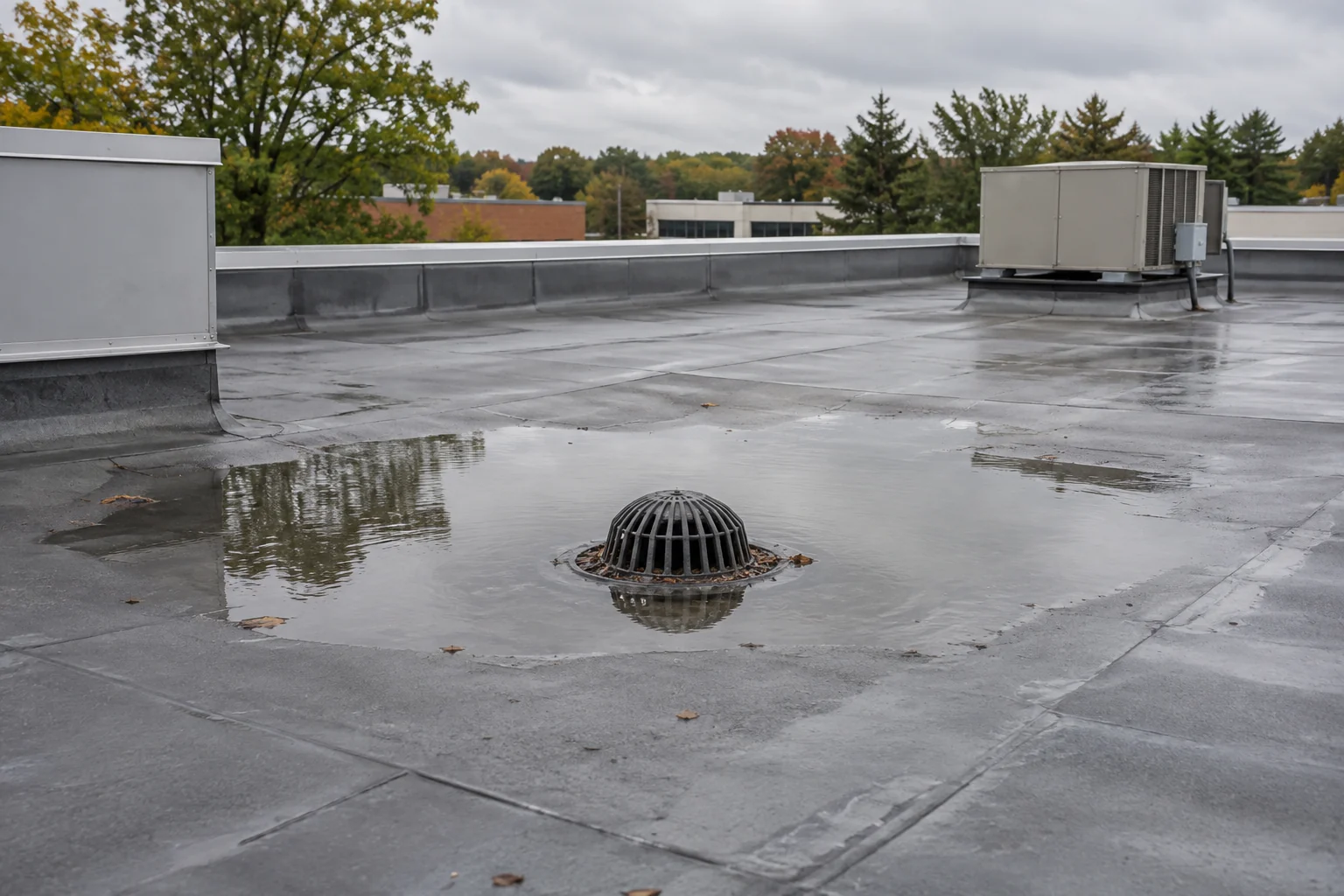
A puddle on a commercial roof can leave you wondering whether you need a repair, a better maintenance plan or a replacement. Recurring standing water deserves a flat roof inspection, but the puddle alone does not identify the cause or tell you which repair is appropriate. Start by recording where it appears, how it changes after rain and whether there are signs of water inside the building.
For building owners in Lanark and the Ottawa Valley, the useful question is not simply whether a flat roof gets wet. It is whether water is leaving the roof as intended. A sound decision considers the drainage route, roof surface and condition of the assembly underneath. Applying a patch before understanding those parts can leave the original problem unresolved.
Look at the pattern, not just one photograph
A photograph taken during a downpour tells a different story from repeated observations after the weather clears. Note when the rain ended and whether the same area remains wet while the surrounding roof dries. Record the location using a recognizable feature, such as a rooftop unit, wall or drain. A dated sequence can be more useful than a close-up with no context.
You do not need to climb onto the roof to start a record. Use existing observations from a safe location and share any maintenance photographs you already have. If the roof is inaccessible, leave the roof-level assessment to the contractor. Wet surfaces, hidden edges and roof openings make an improvised inspection a poor way to investigate a puddle.
Keep indoor observations separate. Identify the room, ceiling area and timing of any drip or stain. Do not assume that water on the roof directly above the stain is necessarily the entry point. McKay’s commercial roof repair service explains that water can travel within the roof assembly before appearing indoors.
Three questions a drainage assessment should answer
Can water reach the drainage outlet?
Leaves and debris around an outlet can interfere with drainage. However, a clear-looking drain does not prove that the whole drainage route is working. The assessment should consider the route water takes across the roof and what happens at the outlet, rather than stopping at the first visible accumulation of debris.
Tell the contractor about recent work on rooftop equipment or changes around the building. This is useful background, not proof that another trade caused the problem. It helps establish whether the wet area is longstanding or appeared after something changed.
Is a low area holding water back?
Water may collect where the surface does not provide an effective route to an outlet. The roofer should distinguish a drainage obstruction from a roof-shape or assembly problem. Those situations can require different responses. A surface coating is not a substitute for deciding how water should leave the roof.
Avoid selecting a repair from a photograph alone. Ask what evidence supports the recommendation and whether the proposal addresses the reason water collects. If concerns extend to structural movement, establish what further professional assessment is needed; do not treat an ordinary roof repair quotation as a structural assessment.
Has water entered the roof assembly?
A drainage problem and a leak are related questions, but they are not interchangeable. The roofer needs to inspect the membrane and details as well as the standing water. Seams, transitions and roof penetrations may need attention even when the wet area looks small.
McKay’s flat-roof guidance distinguishes roofs that may be suitable for recovering from roofs with extensive wet insulation or possible deck issues. That distinction matters: the decision is based on the existing assembly’s condition, not simply whether a new layer would hide the surface.
What to send when arranging an inspection
A short, organized message helps the discussion begin with the right information. Include what you know and leave uncertain details marked as unknown:
- The building address and the area affected, described from inside and outside where possible.
- When the pooling was first noticed and whether it returns in the same place.
- Dated photographs showing both the wet area and nearby roof features.
- Whether there are active leaks, old stains or changes in the ceiling below.
- The roof material and approximate installation date, if documented.
- Previous repair records, warranty paperwork and recent rooftop work.
There is no need to guess the membrane type or invent an installation date. An old invoice or product record is more useful than identifying the system by colour. Likewise, a stain that has been present for years should not be described as a new leak unless something has changed.
If water is actively entering the building, say so when requesting help. Keep people away from affected electrical equipment or visibly compromised ceilings. A roof-inspection appointment is not a reason to keep using an unsafe area while waiting. Do not puncture the roof or ceiling to experiment with drainage.
Two buildings can need different next steps
Consider two hypothetical situations. In the first, a manager notices a new wet area after autumn leaves accumulate around an outlet. There are no reported interior leaks. The appropriate next step is to have the drainage route and roof condition assessed, document any maintenance performed and observe whether the problem recurs.
In the second, water repeatedly collects in the same low area, previous surface repairs have not resolved the problem and ceiling stains are spreading. The inspection needs to look beyond routine cleaning. The owner should ask how the proposed work addresses drainage, what is known about moisture within the assembly and which uncertainties remain.
Neither example establishes a diagnosis for your building. They illustrate why identical-looking puddles do not automatically justify identical quotes. Useful flat roof repair advice connects observations to a defined scope of work.
Read the proposal for what it actually fixes
Ask the contractor to explain the finding, the recommended work and the expected result in plain language. If the proposal is for a localized membrane repair, clarify whether drainage work is included. If maintenance is recommended, ask what follow-up will show whether it resolved the concern.
For more extensive work, distinguish repair, recover and commercial roof replacement. Ask which existing layers would remain, what condition checks support that choice and how unexpected wet or damaged materials would be handled. The answer should be specific to the building rather than a blanket statement that every flat roof needs the same treatment.
McKay’s commercial roof maintenance service describes identifying existing or potential problems and providing recommendations. Its maintenance-program guide offers broader context for keeping inspections and repair records together. A recurring puddle should become a documented maintenance item, not something rediscovered without its history after every storm.
Get Your Free Estimate
Noticing recurring water pooling or a leak in your commercial building? Contact McKay Roofing to discuss a flat roof inspection and the next steps for your roof. Share your observations so the assessment can focus on the affected area and its history.
Request an estimate through our contact form or reach us directly.
Call (613) 259-5766 or contact us to arrange an assessment in Lanark or the Ottawa Valley.