Commercial Roof Maintenance Programs: Protecting Your Building Investment
A commercial roof is one of the largest and most important assets on any building, yet it is also the most overlooked — right up until it leaks. By then, the damage is often extensive and expensive: interrupted operations, damaged inventory, ruined interior finishes, and a repair bill far larger than prevention would have cost. A commercial roof maintenance program changes that equation by catching small problems before they become big ones, extending the life of the roof, and protecting the substantial investment it represents.
This guide explains what a commercial roof maintenance program includes, why preventative maintenance pays for itself, and how scheduled care protects both the roof and the building beneath it. McKay Roofing has maintained commercial roofs across the Ottawa Valley for more than 50 years — see our commercial roof maintenance service for the full offering.
Why Commercial Roofs Need Proactive Maintenance
Commercial roofs — typically flat or low-slope membrane systems — face demands that make proactive maintenance especially important. They carry rooftop equipment, see foot traffic from technicians servicing that equipment, collect debris, and endure standing water and snow load that steep residential roofs shed naturally. Every one of those factors creates wear points that develop slowly and invisibly until they fail.
Unlike a residential homeowner who might notice a problem from the ground, commercial building owners rarely see their roof. Problems develop unseen — a lifting seam, a cracked flashing, a clogged drain, a puncture from dropped equipment — and continue undetected until water finds its way inside. A maintenance program puts trained eyes on the roof regularly so those problems are caught while they are still small and inexpensive to fix.
What a Maintenance Program Includes
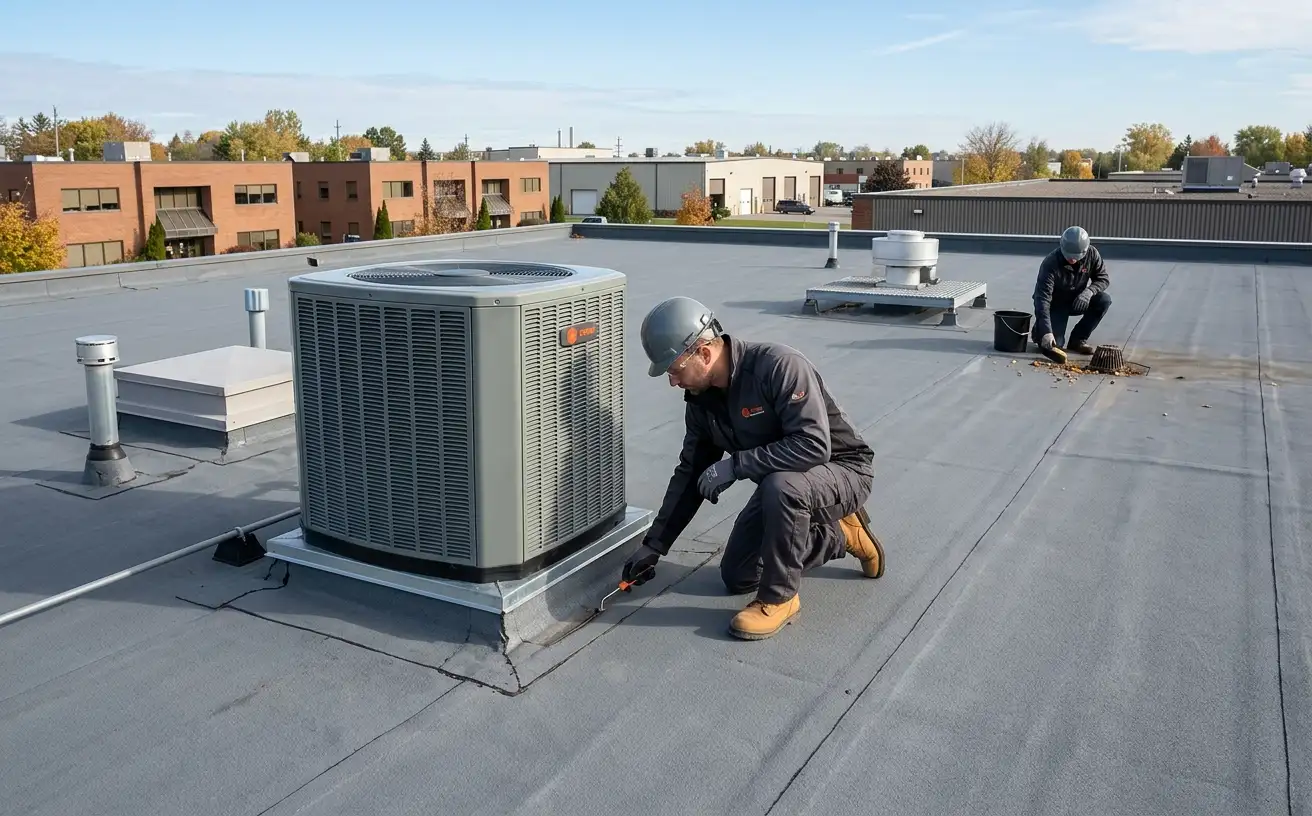
A structured commercial roof maintenance program is more than an occasional look. It typically includes scheduled, documented inspections and preventative care covering:
- Regular scheduled inspections — typically twice yearly (spring and fall) plus after major weather events
- Membrane inspection — checking for punctures, blisters, lifting seams, and surface degradation across TPO, EPDM, modified bitumen, or built-up systems
- Flashing and penetration checks — inspecting the seals around HVAC units, vents, drains, and every other roof penetration, which are the most common leak points
- Drainage clearing — removing debris from drains, scuppers, and gutters so water flows off the roof rather than pooling
- Standing water assessment — identifying areas where water ponds, which accelerates membrane deterioration
- Seam and edge inspection — checking the vulnerable points where the membrane is joined or terminated
- Debris removal — clearing accumulated debris that traps moisture and damages the membrane
- Documentation — recording the roof's condition over time, which supports warranty claims and budget planning
- Minor repairs — addressing small issues on the spot before they grow
The documentation component is particularly valuable. A maintained record of the roof's condition helps with warranty compliance, supports insurance considerations, and lets building owners plan capital expenditures rather than being surprised by them.
The Cost of Neglect
The case for a maintenance program is ultimately financial. Consider what roof neglect actually costs a commercial building.
Emergency repairs cost more than planned maintenance. A leak discovered during operations means an emergency call, rushed work, and premium pricing — versus a small issue caught and fixed during a scheduled inspection. Our guide to commercial roofing leaks details how much damage a small, ignored problem can cause.
Interior damage multiplies the cost. A roof leak does not just damage the roof — it damages ceilings, walls, insulation, electrical systems, inventory, equipment, and finishes. The interior damage frequently exceeds the cost of the roof repair itself.
Business interruption has real cost. Water intrusion can halt operations, close areas of the building, and disrupt customers or tenants. For many businesses, the operational disruption is the most expensive consequence of all.
Premature replacement is the biggest cost. A neglected roof fails years before its designed lifespan, forcing an early full replacement. A maintained roof reaches — and often exceeds — its expected life. Deferring maintenance to save money almost always costs far more in shortened roof life.
How Maintenance Extends Roof Life
The core value of a maintenance program is longevity. Commercial roofing systems are designed to last decades, but only if they are maintained. Small problems, left alone, cascade: a minor seam lift lets water under the membrane, the water degrades the insulation and deck, the compromised area spreads, and eventually a localized issue becomes a system failure requiring replacement.
Regular maintenance interrupts that cascade at the earliest stage. A seam re-secured promptly never becomes a leak. A cleared drain never causes ponding that degrades the membrane. A sealed penetration never lets water into the assembly. By addressing issues while they are small and localized, maintenance keeps the roof performing to its full designed lifespan — turning the roof from a recurring emergency into a predictable, well-managed asset. Many building owners find that pairing maintenance with a roof coating at the right time extends the roof's life even further before replacement becomes necessary.
Warranty Protection
Many commercial roofing warranties actually require regular maintenance to remain valid. Manufacturers know that maintained roofs last longer and fail less, so they build maintenance requirements into their warranty terms. A building owner who neglects maintenance may discover, when a problem arises, that the warranty has been voided by the lack of documented care.
A structured maintenance program with proper documentation protects warranty coverage by demonstrating that the required care was performed. This is one of the less obvious but most important benefits — the program does not just extend the roof's physical life, it preserves the financial protection the warranty represents.
Seasonal Considerations in the Ottawa Valley
Ontario's climate makes commercial roof maintenance especially important, and it shapes the maintenance calendar.
Spring inspection assesses the damage winter may have caused — ice loading, freeze-thaw stress on seams and flashings, and any issues that developed under snow cover. Spring is the time to catch and repair winter damage before it worsens.
Fall inspection prepares the roof for winter — clearing drains so meltwater flows freely, confirming seams and flashings are sound before they are stressed by ice, and addressing any issues while conditions still allow good repair work.
Winter monitoring addresses snow load, which on large flat commercial roofs can become significant. Our guide on roof snow and ice removal covers why flat commercial roofs need particular attention when snow accumulates. Combining maintenance with snow monitoring gives the building comprehensive winter protection.
Who Benefits Most From a Maintenance Program
A maintenance program makes sense for essentially any commercial building, but the value is highest for:
- Buildings with large flat roofs that collect debris, water, and snow
- Facilities with rooftop equipment that requires servicing and creates traffic and penetrations
- Buildings where interruption is costly — retail, manufacturing, warehousing, offices with sensitive equipment
- Owners managing multiple properties who need predictable roof budgeting across a portfolio
- Buildings with roofs still under warranty that requires documented maintenance
- Older roofs where proactive care can extend life and defer the cost of replacement
Maintenance vs. Reactive Repair
The choice every building owner makes — consciously or not — is between managing the roof proactively or reacting to problems as they arise. Reactive management means waiting for leaks, paying emergency rates, absorbing interior damage and business disruption, and replacing the roof early. Proactive management through a maintenance program means predictable costs, minimal disruption, preserved warranties, and a roof that lasts its full life.
For repairs that do become necessary, our commercial roof repair services handle them — but the goal of a maintenance program is to keep those repairs small, planned, and rare. And when a roof does eventually reach the end of its life, a building owner with good maintenance documentation is far better positioned to plan the roof replacement on their own timeline rather than in a crisis.
Get Your Free Estimate
Protect your building investment with a structured commercial roof maintenance program. Our team will assess your roof and design a maintenance schedule that fits your building and budget — no obligation.
Fill out the form or reach us directly.
Call us at (613) 259-5766 or contact us to discuss a maintenance program for your building.
An Investment That Pays for Itself
A commercial roof maintenance program is not an expense — it is protection for one of the largest assets on your building and insurance against the far greater costs of neglect. Regular inspections, prompt minor repairs, cleared drainage, and proper documentation keep the roof performing to its full lifespan, preserve warranty coverage, and prevent the emergencies that disrupt operations and drain budgets. For Ottawa Valley building owners, a maintenance program is one of the smartest financial decisions available for the roof overhead. McKay Roofing has protected commercial buildings across the region for more than 50 years.