Attic Insulation and Your Roof: How the Right Insulation Protects Your Investment
Most homeowners think of attic insulation purely in terms of heating and cooling bills. It certainly affects those, but insulation does something else that matters just as much: it protects your roof. In Eastern Ontario's demanding climate, the relationship between attic insulation and roof health is direct and important — inadequate insulation is a leading cause of ice dams, premature shingle aging, and moisture problems that shorten the life of a roof.
This guide explains how attic insulation and your roof are connected, what R-value means for our climate, the insulation types available, and why insulation and ventilation must work together. After more than 50 years of roofing work across the Ottawa Valley, we have seen how often roof problems trace back to what is — or is not — in the attic.
How Insulation and Roof Lifespan Connect
The connection between attic insulation and roof health comes down to temperature and moisture control.
In winter, a well-insulated attic keeps household heat inside the living space where it belongs. This keeps the attic — and the roof deck above it — cold. A uniformly cold roof deck is exactly what you want in winter, because it prevents the melt-and-refreeze cycle that creates ice dams. When insulation is inadequate, household heat escapes into the attic, warms the roof deck, melts the snow on the roof, and sets up the conditions for ice dams to form at the cold eaves.
In summer, insulation slows the transfer of attic heat down into the living space, reducing cooling costs and preventing the extreme attic temperatures that can accelerate shingle aging from below.
Year-round, proper insulation combined with proper ventilation keeps the attic dry, which protects the roof deck, the framing, and the underside of the roofing material from moisture damage. A roof is only as healthy as the attic beneath it.
R-Value Explained for Eastern Ontario
R-value is the measure of insulation's resistance to heat flow — the higher the R-value, the better the insulation resists heat transfer. Different climates call for different R-values, and Eastern Ontario's cold winters demand substantial attic insulation.
For our climate zone, attic insulation is generally recommended in the range of R-50 to R-60. Many older Ottawa Valley homes were built or last insulated to much lower standards — sometimes R-20 or less — which leaves them under-insulated by modern expectations. Homes built decades ago frequently have attic insulation that has settled, compressed, or degraded over the years, reducing its effective R-value well below what it was when installed.
Adding insulation to reach the recommended R-value for our climate is one of the most cost-effective improvements a homeowner can make — it reduces energy bills, improves comfort, and protects the roof all at once.
Insulation Types
Several insulation types are used in Ottawa Valley attics, each with its own characteristics.
Batt Insulation
Batt insulation comes in pre-cut rolls or sections, typically fibreglass or mineral wool, fitted between the attic joists. It is widely used, cost-effective, and straightforward to install in accessible attics with standard joist spacing. Batts can leave gaps if not fitted carefully, which is why installation quality matters.
Blown-In Insulation
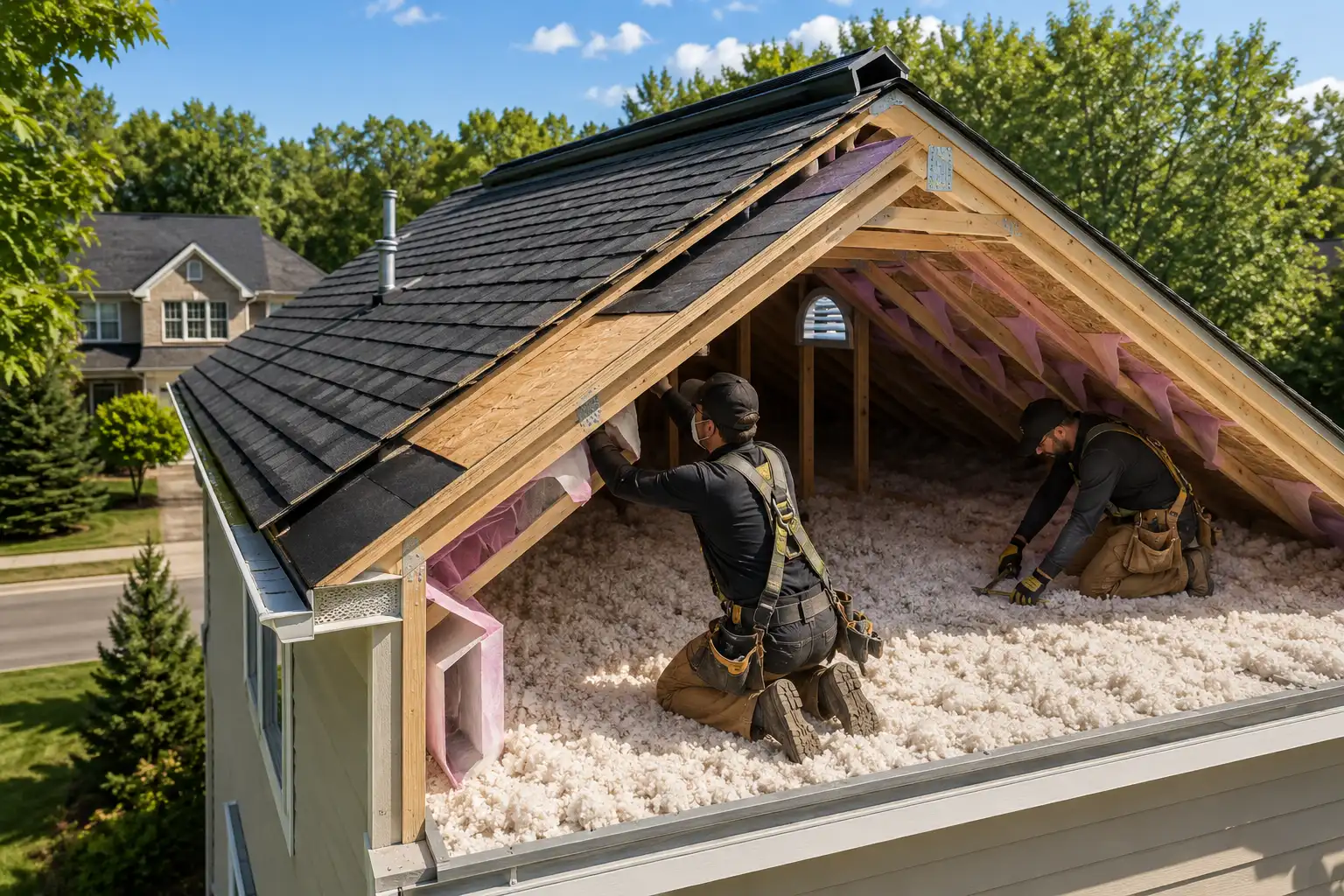
Blown-in (loose-fill) insulation — usually cellulose or fibreglass — is blown into the attic with specialized equipment, filling gaps and covering irregular spaces that batts struggle to reach. It is excellent for topping up existing insulation and for attics with obstructions or irregular framing. Blown-in insulation provides consistent coverage and is often the preferred method for bringing an under-insulated attic up to modern R-values.
Spray Foam Insulation
Spray foam expands on application to create an air-sealing insulation layer with a high R-value per inch. It excels at sealing air leaks and is used in specific applications, though it costs more than batt or blown-in. Spray foam is sometimes used for particular problem areas or specialized attic assemblies.
The right insulation type depends on your attic's configuration, existing insulation, accessibility, and budget. Many attic upgrades combine methods — for example, blowing additional loose-fill over existing batts to reach the target R-value.
The Insulation and Ventilation Partnership
Here is the most important thing to understand about attic insulation: it does not work alone. Insulation and ventilation are partners, and neither performs correctly without the other.
Insulation keeps heat in the living space and out of the attic. Ventilation removes any heat and moisture that does reach the attic, keeping the space dry and the roof deck cold. If you insulate heavily but ventilate poorly, moisture becomes trapped in the attic, leading to condensation, mould, and roof deck rot. If you ventilate well but insulate poorly, household heat escapes into the attic and drives ice dams and energy loss.
The two systems must be balanced and working together. A critical detail: insulation must never block the soffit vents that provide the attic's intake airflow. When insulation is added without proper baffles at the eaves, it can smother the soffit vents and choke off the ventilation the roof needs. Our guide on attic ventilation covers the airflow side of this partnership, and our attic ventilation guide explains how intake and exhaust work together.
When we assess an attic for insulation, we always assess the ventilation at the same time, because improving one without the other rarely solves the underlying problem.
How Poor Insulation Causes Ice Dams
Ice dams are one of the most damaging winter roof problems in the Ottawa Valley, and inadequate attic insulation is one of their primary causes.
The mechanism works like this: household heat escapes through poorly insulated ceilings into the attic. That heat warms the roof deck. Snow on the warmed upper portion of the roof melts and runs down toward the eaves. The eaves — which overhang the exterior wall and are not warmed by attic heat — stay cold, so the meltwater refreezes there, building up into an ice dam. Water then backs up behind the dam, works its way under the shingles, and leaks into the home.
Proper insulation breaks this cycle by keeping the roof deck uniformly cold, so snow does not melt unevenly. Combined with good ventilation and proper ice and water shield membrane, adequate insulation is the homeowner's best defence against ice dams. For the repair side of ice dam problems, see our ice dam repair services.
Signs Your Attic Insulation Is Inadequate
Several signs point to insufficient or degraded attic insulation:
- Ice dams forming every winter — a strong indicator of heat escaping into the attic
- High or rising heating and cooling bills — insulation loss shows up on the energy bill
- Uneven indoor temperatures — rooms that are hard to heat or cool
- Cold ceilings or drafts — heat escaping upward
- Snow melting unevenly on your roof — patchy melt patterns indicate heat leaking through the roof deck
- Visible insulation that looks thin, compressed, or patchy when you look into the attic
- Attic that feels extremely hot in summer — inadequate insulation combined with poor ventilation
Any of these signs is worth investigating. Insulation problems are often invisible until they show up as ice dams, high bills, or roof damage.
Upgrading Insulation During a Roof Project
A roof replacement is an ideal time to address attic insulation, and the two projects complement each other naturally.
When the roof is being replaced, the attic and its ventilation are already under evaluation. Any ventilation improvements — new soffit vents, ridge venting, proper baffles — can be coordinated with insulation upgrades so that the whole system is balanced when the project is complete. Addressing insulation, ventilation, and roofing together produces a roof system that performs far better than replacing the shingles alone.
This integrated approach is particularly valuable for older Ottawa Valley homes, where the original insulation and ventilation often fall short of modern standards. Bringing all three elements up to current standards at once maximizes the lifespan of the new roof and the comfort of the home. Our guide on what affects the cost of a new roof covers how ventilation and related upgrades factor into a roofing project.
Energy Savings and Comfort
Beyond protecting the roof, proper attic insulation delivers immediate, tangible benefits to the home. Heating costs drop in winter as household heat stays where it belongs. Cooling costs drop in summer as attic heat is kept out of the living space. Indoor temperatures become more even and comfortable, with fewer cold spots and drafts.
In a climate like Eastern Ontario's, where winters are long and heating costs are significant, the energy savings from bringing an under-insulated attic up to modern R-values can be substantial. The improvement pays for itself over time while simultaneously protecting the roof — a rare upgrade that benefits comfort, cost, and roof longevity all at once. For related energy considerations, see our guide on how your roofing can help you save energy.
Why Professional Assessment Matters
Attic insulation might look like a simple matter of adding more material, but doing it correctly requires understanding the whole attic system. Insulation must be the right type and depth, installed without blocking ventilation, with proper baffles at the eaves, air sealing where needed, and coordination with the ventilation system.
A professional assessment evaluates the existing insulation, the ventilation, the condition of the roof deck, and any signs of past moisture problems — then recommends an approach that addresses the attic as a complete system. This is particularly important when insulation problems and roof problems are connected, which they frequently are. Working with an experienced local roofing contractor who understands the whole attic-and-roof relationship produces far better results than treating insulation in isolation.
Get Your Free Estimate
Concerned about ice dams, high energy bills, or an under-insulated attic? Our team will assess your attic insulation and ventilation together and recommend the right approach — with no obligation.
Fill out the form or reach us directly.
Call us at (613) 259-5766 or contact us to schedule your on-site assessment.
Protecting Your Roof From the Inside
The health of your roof depends on more than the shingles or panels on top — it depends on what is happening in the attic below. Proper insulation, working in partnership with proper ventilation, keeps the roof deck cold in winter, prevents ice dams, controls moisture, and extends the life of the entire roof system. For Ottawa Valley homeowners, addressing attic insulation is one of the smartest investments you can make in both your comfort and your roof's longevity. McKay Roofing has been helping homeowners get the whole system right for more than 50 years.